Service portfolio and commitments
Define services, offerings and commitments.

CSM connects service commitments to the applications, deployments, resources and operational work that deliver them. One information model across ServiceHub, AgentHub and ExpertHub.
The whitepaper defines the conceptual reference and recommended practice. These online guides explain documented capabilities and later implementation clarifications.
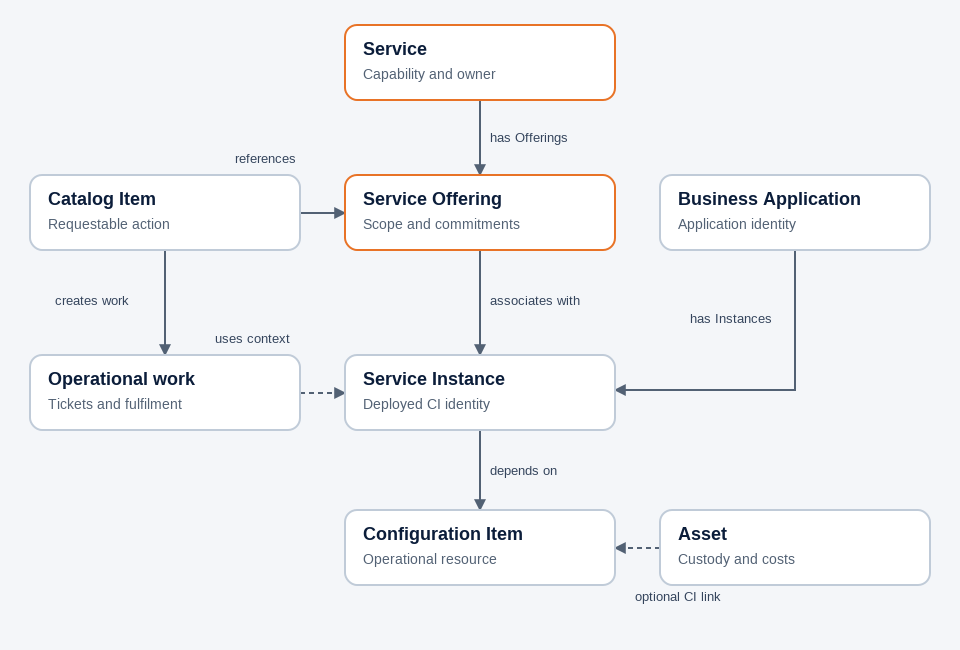
| Record | Question | Example |
|---|---|---|
| Service | What outcome do we support? | Employee Collaboration |
| Service Offering | Under which scope and commitments? | Business Hours Support |
| Business Application | Which application is managed? | Employee Portal |
| Service Instance | Which concrete deployment? | Employee Portal PROD |
| Configuration Item | Which operational resource? | PROD database |
| Catalog Item | What action may be requested? | Request Portal access |
| Asset | Who holds it, where is it, what is its commercial history? | Laptop AST000123 |
One application can have PROD and TEST Instances. One Instance can participate in several Offerings. A Catalog Item describes an action; the Offering describes its service commitment. Assets and CIs retain separate identities and authority.
Understand entities and relationshipsDefine services, offerings and commitments.
Describe business applications and their context.
Connect the components that support delivery.
Connect demand, catalog requests and fulfilment.
Manage physical resources and supply relationships.
Connect operational work with reusable knowledge.
An owner is accountable, a team performs work and a supplier is a commercial party. Shared vocabulary helps connect those responsibilities without treating them as interchangeable.
Services define capabilities and accountability. Offerings define support scope, assigned teams, schedules and priority-based targets. Explicitly select a usable default Offering before relying on normal routing.
Explore Services and Offerings →Keep an application identity separate from its deployments. Associate Offerings and Instances with delivery, support or management roles, then describe resource dependencies through directed CI relationships.
Connect Service Instances →Association role, relationship type and impact mode are different concepts. A descriptive connection can carry no automatic impact. A potential technical consequence does not establish observed downtime.
Model dependencies and interpret impact Explore Configuration ManagementPeople identify a service or request a catalog action. They track the work without having to model the technical infrastructure.
Agents use Contacts and applicable Service Desk Instructions to understand the need, preserve the conversation and connect formal work.
Specialists use service commitments, technical context and related work to restore service, fulfil requests and coordinate controlled change.
An Employee Portal incident uses its Offering for normal support context. Staff can add the PROD database CI, inspect potential impact and connect Problem and Knowledge follow-up.
A new-starter request coordinates equipment and access. Actual Assets retain custody history. Production modifications retain their own Change authorization and scheduling controls.
Establish Services, Offerings, teams and support commitments without requiring a technical dependency map. Good ownership and governance already matter here.
Add configuration-connected work where Configuration Management and relevant permissions are enabled. Switching views does not discover resources or validate graph quality.
These are views over a shared model, not pricing tiers or maturity certificates. Asset Management and Analytics have independent activation and access controls.
Understand your setupThese stages are recommended practice. They are not an automated completeness score. The historical naming migration is completed; current labels are ITSM Lite and CSM Full.
Offering schedules and response/resolution targets establish support context. Individual measurements record what happened.
CI traversal identifies potential consequences using configured semantics. Missing links and simplified redundancy rules affect the result.
Actual disruption needs explicit evidence. Availability reports require stated target scope, schedules and careful treatment of overlap and propagation limits.
CSM is an information model and guidance baseline. It does not imply vendor-model certification, automated discovery, full software licence compliance or complete financial accounting.
Establish useful ownership and commitments, then connect, govern and measure.
CSM GUIDESeparate capabilities, commitments, application identities, deployments and requestable actions.
CSM GUIDEDistinguish targets, support clocks, maintenance constraints, predicted impact and measured downtime.
CSM GUIDEChoose relationship direction and impact meaning, then validate a failure scenario.
CSM GUIDEClassify legacy records, rehearse mappings and preserve integration and historical meaning.
CSM GUIDEUse a shared language for service commitments, deployments, resources and operational work.
CSM GUIDEConnect service intake, fulfilment, restoration, controlled change and reusable knowledge.
Download the original Connected Service Model whitepaper, version 1.0, dated 2 October 2026. Its 25 pages cover principles, conceptual and system models, six domains, relationship semantics, governance and adoption.
The PDF is the original proposed reference baseline. Online guidance includes later implementation clarifications; model recommendations do not establish automatic product enforcement.
Explore how Bourgos could work for your organisation, with shared context through the Connected Service Model.